Myriuna
The world a player inhabits
Campaign creation, actors, scenes, choices, freeform action, Chronicle history, presentation, and the practical experience of playing inside a world.
Product and engine
Myriuna is a game for creating and inhabiting persistent worlds built around artificial intelligence.
Myriuna Core is the engine underneath it: the layer that preserves actors, knowledge, relationships, rules, history, and consequence while replaceable models render the current moment in prose.
The basic distinction
The player-facing product is where people create or choose actors, enter worlds, act in natural language, and experience what follows. Myriuna Core is the system that makes those experiences belong to one continuous reality.
Myriuna
Campaign creation, actors, scenes, choices, freeform action, Chronicle history, presentation, and the practical experience of playing inside a world.
Myriuna Core
Authoritative state, validation, modules, actor knowledge, relationships, events, rules, persistence, scheduling, and the reconstruction of the reality a model is allowed to render.
The product is what a player inhabits. The engine is what allows it to continue.
World modules
Myriuna does not place an all-powerful language model above the world as an AI game master. A module defines the social contract under which play occurs: what exists, which rules apply, who holds authority, what people may know, what creates obligation, how consequences are recognised, and how a setting tends to escalate.
The model performs inside that contract. It can write dialogue, description, emotion, interpretation, and atmosphere. It does not receive unilateral authority to decide what reality is.
World structure
A module can define households, professions, institutions, permissions, local authority, danger, taboo, schedules, resources, and the assumptions people organise their lives around.
Social structure
It can define what counts as trust, fear, debt, loyalty, kinship, reputation, hostility, obligation, testimony, rumour, and legitimate evidence.
Narrative structure
A module can shape prose, pacing, likely tensions, escalation rules, and world-specific expectations without predetermining the story the player must follow.
A module is not merely lore, a character list, or a folder of prompts. It is executable social structure.
Player agency
A scene may present three likely continuations so play can move forward easily and future systems can prepare probable paths. Those choices are invitations, not the entire action space.
The player may instead enter another action in natural language. Myriuna interprets that intent against the current actor, location, knowledge, relationships, abilities, conditions, rules, and established continuity.
The player is an actor in the world—not the person the model has been instructed to satisfy.
Every participating entity is represented as an actor, including the player character. The model therefore encounters the player character as an ordinary person within the setting rather than as a privileged user whose declared outcome must become true.
Freeform play means you can attempt what occurs to you. It does not guarantee success. An action may succeed, fail, meet resistance, produce an unintended result, or be refused when it contradicts the world.
Narrative physics
Most games devote their deepest systems to physical questions: where something is, what it struck, how fast it moved, and how much damage followed. Myriuna is built to make a different family of questions playable.
Witness
Their later reaction can be grounded in direct knowledge, filtered through what they noticed, misunderstood, feared, or chose not to reveal.
Rumour
Information may travel as testimony, gossip, distortion, accusation, leverage, or a sincere but incomplete retelling.
Ignorance
They should not react merely because the model was shown the event. Actor knowledge remains bounded by the world.
Delayed consequence
An event can return because it affected a relative, a debt, a duty, a reputation, access, or a relationship that only becomes relevant later.
The story improvises. The world keeps score.
Authority and expression
The engine owns world truth: what exists, what happened, what each actor may know, which rules apply, and which consequences are permitted to become real.
The language model receives a bounded local reality and turns it into a scene. It may be lyrical, restrained, tense, gentle, suspicious, funny, or surprising. Its freedom lies in performing the moment, not in silently rewriting the world underneath it.
Narrative rendering
A long-running universe can contain far more than any current model should receive at once. Myriuna reconstructs the relevant frame from durable state: the current place, nearby actors, bounded knowledge, relationships, recent history, open threads, conditions, and applicable rules.
Model context is temporary working memory. The world is the record from which that working memory is rebuilt.
The goal is not to push the entire universe into one enormous prompt. It is to present the right reality, at the right resolution, from the right perspective, under the right authority.
Because the world remains outside the current scene, it can be inspected, corrected, backed up, migrated, stopped, restarted, and resumed. A later model can render the same governed universe without inheriting authority over its history.
Text-first lineage
Myriuna is, in part, a mature descendant of text adventures. Those games used rooms, objects, parsers, flags, and scripted state to make players imagine corridors, forests, locked doors, distant settlements, and impossible places without rendering every surface.
Myriuna keeps text’s speed, flexibility, and suggestive power, then places generated prose over governed world state rather than rigid scripts.
Human imagination
A few grounded details can allow the player to complete a room, a road, a face, or an entire settlement in ways fixed imagery cannot prescribe.
Playable breadth
A quiet conversation can become travel, work, suspicion, politics, danger, or reconciliation without first building every possibility as a visual scene.
Generated media
Verified scene output may later become structured input for voice, images, video, music, maps, ambience, or a visual engine. Those systems extend presentation; they do not become world truth.
World state first. Text renders the playable experience. Additional media render that experience further.
Actor simulation
A full simulation can give every actor model-driven turns. Most playable modules are expected to combine those turns with chance, dice, schedules, rules, and lighter background progression so the wider campaign continues without generating a full scene for every person during every loop.
How often an actor receives a guaranteed action is itself a source of influence. Major actors, nearby participants, and the player may receive more frequent or more expensive cognition. Background actors may advance through rules until something makes their decisions locally important.
This keeps the player semi-central without freezing the rest of society. The world can continue to produce work, travel, absence, changing obligations, rumours, and local consequences while reserving detailed model performance for moments that need it.
State persists without an active turn.
Rules, chance, schedules, or dice advance the actor.
The actor receives intent, memory, or lightweight model work.
Full prose and dialogue render the visible moment.
First reference world
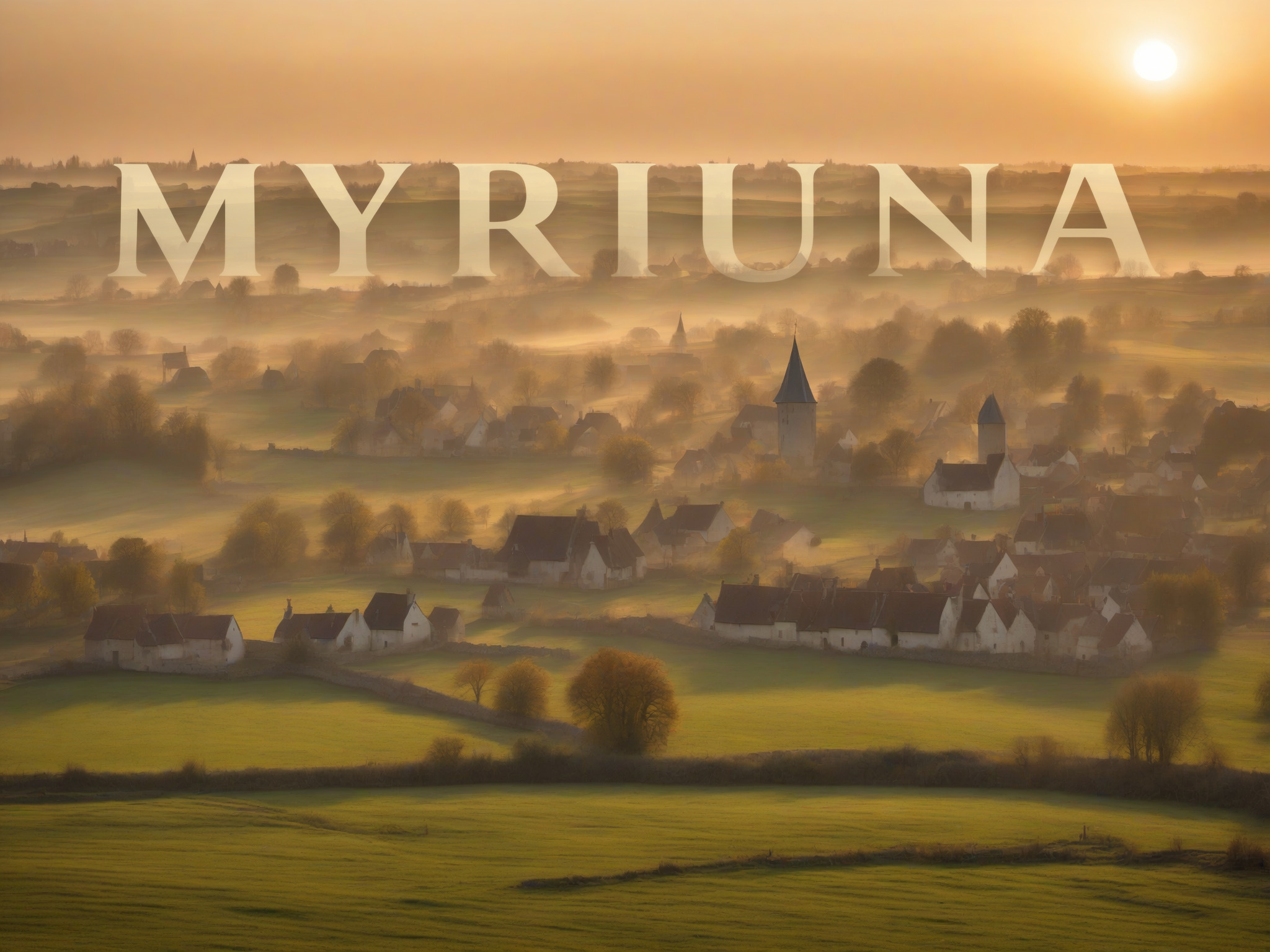
The first module is a broad original low-fantasy foundation without magic. It begins with ordinary people, roads, fields, households, trades, customs, rumours, promises, debts, work, travel, practical danger, and local authority.
It is deliberately ordinary. Spectacle can dominate every result around it and hide whether the underlying continuity works.
A farmer who remembers a broken promise is more useful to the first test than a dragon.
The planned first real playtest uses roughly fifty villagers. The player enters as one actor among the cast. The test is whether actions become durable events, knowledge spreads unevenly, relationships change, later scenes reflect those changes, and the system can explain why.
Future modules may define court intrigue, a space station, a caravan, a school, a guild, a mystery manor, or a post-apocalyptic settlement. The reference world proves the engine; it does not define the engine’s limit.
Local-first continuity
Myriuna is local-first because its worlds are intended to outlive the hosted service that may present them. One universe running the core text-first experience is designed to remain playable on one capable machine.
The richer product already uses a distributed architecture. Local machines and compatible cloud services can provide additional model workers, prerendering, voice, imagery, video, and other compute without becoming the only keeper of the universe.
A world should end because the story ends—not because the context window moved on, the service disappeared, or the model forgot.
If the service ends, the commitment is to make each user’s world data and the software required for the core campaign available so the universe can continue locally in text.
Early research also showed that cloud computing would consume the largest part of the development budget. Heavy generation and repeated testing therefore run primarily on local hardware during development. Continuity created the requirement; development cost reinforced the architecture.
Clear boundaries
Some familiar comparisons explain part of Myriuna, but none of them should be mistaken for the product itself.
Not a chatbot
History, knowledge, state, and consequence do not live only inside the current exchange with a model.
Not an AI game master
The model performs inside world rules. It does not independently own truth, judgement, memory, and consequence.
Not unlimited wish fulfilment
The player can attempt anything plausible, but remains an actor subject to circumstances, ability, authority, and consequence.
Not one fantasy game
Low fantasy provides the opening foundation. Myriuna Core is intended to support different worlds with different social physics.
Not a visual-engine replacement
Visual engines can render bodies and space. Myriuna is concerned with memory, knowledge, law, relationships, and social consequence.
Not a promise of artificial life
The honest promise is persistent, inspectable, configurable world behaviour—not perfect people, infinite content, or flawless autonomy.